T-Shirt Printing
T-Shirt Printing for Clubs and Events: A Buyer’s Guide
16 September 2026 · 8 min read
Why club and event orders go wrong more often than they should
Ordering T-shirts for a sports club, tournament, or one-off event looks simple until you're actually doing it. Someone volunteers to "sort the shirts," a logo gets sent over as whatever file happened to be lying around, and three weeks later the boxes arrive with colours that don't match the club crest, sizing that's left half the under-11s squad swimming in fabric, and a print that's already cracking after one wash.
None of that is really anyone's fault. Most people ordering shirts for a club or event do it once or twice a year, if that — there's no reason to already know the difference between print methods, or what a "print-ready" file actually means. This guide is meant to close that gap before you order, not after.
Screen print, DTF, or DTG — and why it actually matters for your order
The print method isn't just a technical detail your printer sorts out in the background. It affects durability, cost per shirt, minimum order sizes, and what you can actually put on the shirt — and picking the wrong one for your situation is the single most common reason club orders disappoint.
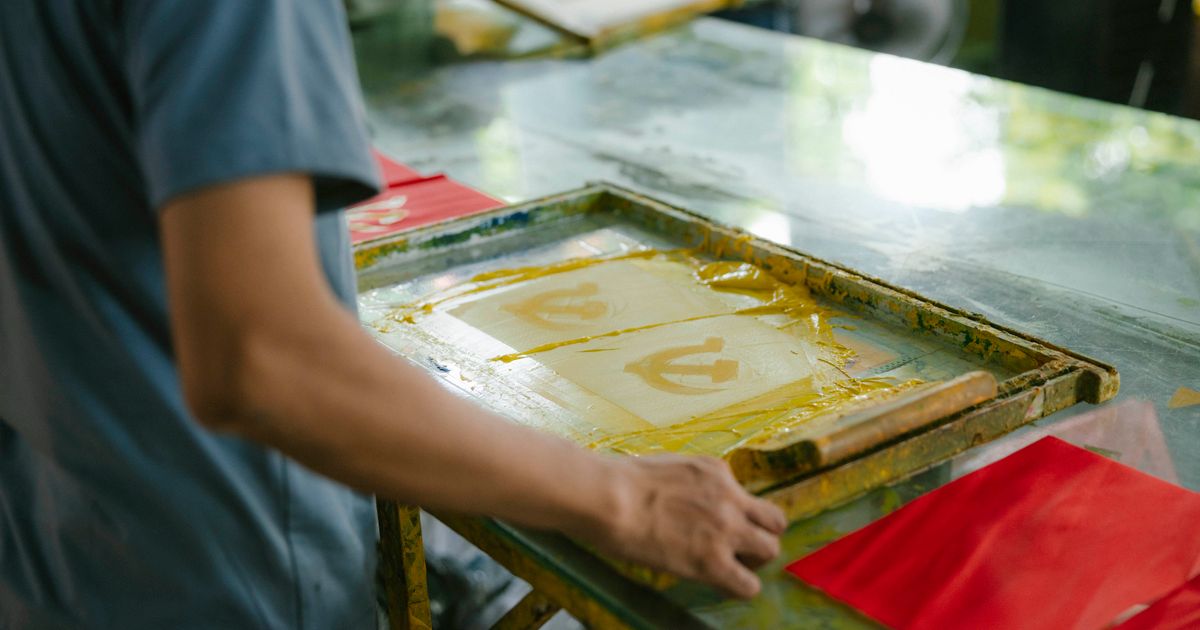
Screen printing pushes ink through a mesh stencil, one colour at a time. It's the most durable option and the cheapest per shirt once you're printing in bulk, because the setup cost is spread across a large run. The trade-off is that setup cost: each colour needs its own screen, so it suits simple, one-or-two-colour designs printed in decent quantities (think 20+ shirts of the same design) rather than a one-off order of five shirts with a five-colour crest.
DTF (direct-to-film) prints the design onto a film, then heat-presses it onto the shirt. It handles full-colour designs and gradients well, doesn't need separate setup per colour, and works economically at much smaller quantities than screen printing — which makes it a strong fit for a lot of club and event orders that don't hit screen-printing volumes. It's also more forgiving of last-minute design tweaks, since there's no screen to remake.
DTG (direct-to-garment) prints straight onto the fabric like an inkjet printer, which is ideal for highly detailed, photographic, or many-colour designs, and for orders where every shirt might be slightly different (player numbers, individual names). It tends to cost more per unit than DTF at volume and can be less durable on dark fabrics specifically, so it's worth confirming garment colour before committing to it.
For most sports clubs and event organisers, the practical shortlist is: screen printing for a simple crest across a genuinely large run (a full season's playing kit, for example), and DTF for most other cases — smaller runs, full-colour designs, or when you need flexibility on quantities per size.
Sizing: the thing that causes more complaints than the print itself
Print quality gets the attention, but sizing is what actually generates the most complaints after a club order lands — and it's the most preventable problem on this list.
A few things worth doing before you finalise numbers:
- Get an actual size run, not guesses. For adult sizing, don't assume your squad's shirt sizes match a generic size chart — brands and garment types vary more than people expect. If it's feasible, have people check against a sample or a size guide from the specific garment you're ordering, not "what size they normally wear."
- Kids' sizing needs its own pass. Youth sizing conventions vary a lot between suppliers (age-based vs. chest-measurement-based), and this is where the biggest sizing complaints tend to come from. Don't extrapolate from adult sizes.
- Order a small buffer, not exact numbers. A handful of spare shirts in common sizes covers late sign-ups, growth spurts mid-season, and simple mistakes in the original size count — cheaper than a rushed reorder later.
- Confirm garment fit, not just size label. Athletic-cut and standard-cut shirts in the "same" size can fit noticeably differently, which matters more for team kit than for a one-off event tee.
What "print-ready" actually means for your design file
This is the part that causes the most back-and-forth between clubs and printers, because "just send us the logo" hides a lot of assumptions.
A print-ready file is usually vector (built in software like Illustrator, not a photo or a screenshot) or, at minimum, a high-resolution flat image with no compression artefacts — a logo pulled off a website or lifted from a WhatsApp group photo will look fine on screen and rough once it's blown up and printed. Colours ideally need to be specified precisely (Pantone or a confirmed colour code) if matching a club's exact brand colours matters, rather than "the blue from our website," which can render differently depending on the screen it was checked on.
If you don't have a proper vector file of your club crest or event logo, say so upfront rather than sending the best version you've got and hoping — most printers, including us, can recreate or clean up a rough logo into something production-ready, but that's a different (and sometimes billable) step from simply printing a file that's already correct.
Turnaround times and when to actually place the order
Turnaround depends on print method, quantity, and how clean the design files are when they arrive — a file that needs recreating from scratch adds time before production even starts. As a general rule, build in more lead time than you think you need, especially around:
- Season starts, when every club in the area is ordering kit at once and print queues fill up.
- Designs still being finalised — a shirt can't go into production while the crest is still being tweaked, so treat design sign-off as the real start of the clock, not the order date.
- Multi-size, multi-quantity orders, which take longer to plan and QA than a flat run of one size.
If there's a hard deadline — a tournament date, a launch event — say so as early as possible and confirm it explicitly with whoever's printing, rather than assuming "a few weeks" covers it.
What actually moves the price per shirt
Cost per shirt is driven by a smaller set of factors than people expect:
- Print method and design complexity — screen printing at volume is cheapest per shirt for simple designs; DTF handles complex, full-colour designs without a big volume requirement but usually costs more per unit at very high quantities.
- Garment quality — a heavier, better-constructed blank shirt costs more before any printing happens, and it's usually worth it for kit that needs to survive a season of matches and washes versus a one-off event tee.
- Number of colours and print locations — front-only is cheaper than front-and-back; more colours in a screen-print design means more screens and more setup cost.
- Quantity — the classic economy of scale, most pronounced with screen printing, less pronounced (but still present) with DTF.
- Rush turnaround — printers can usually accommodate tight deadlines, but expect a premium for jumping the queue.
A short checklist before you place the order
- Confirm the print method suits your quantity and design complexity, not just whichever a friend used last time.
- Get a proper vector or high-res file of the logo/crest — or flag early that it needs recreating.
- Confirm exact colours, especially for club branding that needs to match existing kit or signage.
- Get real sizing, with separate attention to kids' sizes if relevant, plus a small buffer.
- Confirm the deadline explicitly and work backwards from it, accounting for design sign-off time.
- Ask for a mockup or proof before full production — a five-minute check here prevents a much more expensive fix after printing.
How we handle club and event print runs
We handle the parts that usually trip up a volunteer-run order: cleaning up or rebuilding a logo into a proper print-ready file, recommending the print method that actually fits your quantity and design rather than defaulting to whichever is easiest for us, and producing front, back, and sleeve mockups before anything goes to production so there are no surprises when the boxes arrive. We've done exactly this kind of run before — see our Deeper Experience T-shirt design case study for an example of a full design-to-print job. You can see how this fits alongside our wider T-shirt printing and design service, including sizing and vendor coordination for larger campaign or club runs.
The bottom line
Most club and event T-shirt orders that go wrong don't go wrong because of a bad printer — they go wrong because sizing, files, and timelines weren't nailed down before the order was placed. Get those right, pick the print method that actually suits your quantity and design, and the print itself is usually the easy part.
If you're planning a run and want a straight read on print method, timeline, and rough cost before you commit, see indicative packages on our pricing page or book a quick call — it's a lot cheaper to ask the awkward questions before the order goes in than after the boxes arrive.